Scavenge raw materials away from the train, bring them back to onboard stations, refine them into usable inputs, then craft weapons, equipment, repairs and train upgrades. Only one concrete weapon recipe is currently readable in published material, so this guide avoids filling missing tables with guesses.
- Crafting base
- Onboard Eden Engine stations
- Weapons
- Craftable and modular in published design
- Repair
- Dedicated workstations added in development
- Relics
- Found in dungeons; activated aboard train
- Complete recipe list
- Not public
Use the production loop
- Collect with a purposeChoose materials for the next repair, recipe or train improvement instead of filling every slot with low-priority salvage.
- Return before the haul becomes a lossCold and combat can turn an extra room of loot into a failed expedition.
- Refine only what the next task needsMetal, wood and plastic are described through staged refinement chains in current independent documentation.
- Use the right stationWeapon assembly, repair and broader train production have distinct contexts. Read the station name and visible requirements.
- Keep old numbers datedA screenshot value belongs to that displayed pre-release build, not every later beta update.
- Leave missing values blankDo not infer durability, craft time, rarity or drop rate from icon art.
Why the train is the production hub
Official store material describes the Eden Engine carrying crafting stations, storage and the infrastructure needed to turn salvage into survival capacity. Upgrades can reinforce walls, add weapon stations, improve the engine and expand the train with new carriages.
That makes the return trip part of crafting. Materials outside the train are only potential value until the crew brings them back and has the station, recipe and time to use them.
Modular weapons and the visible rifle recipe
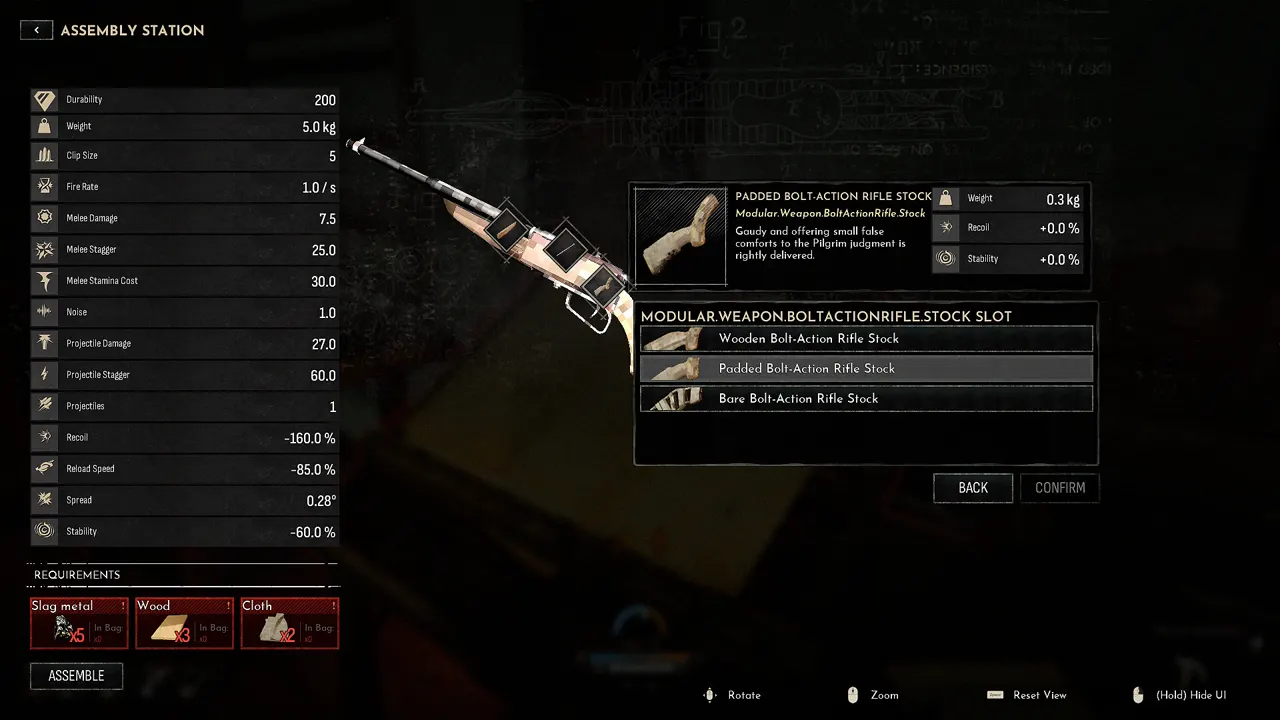
The current Steam gallery includes a weapon assembly interface. Independent inspection identifies a Bolt-Action Rifle with stock choices and a visible requirement of five slag metal, three wood and two cloth. The same screen shows pre-release weapon values.
Those numbers are useful as a dated screen record, not a permanent balance table. The database keeps them together with their image context and does not rank the weapon against unnamed guns.
Repair workstations and Relics
The May development update says the item-repair system was reworked around dedicated repair workstations. It does not publish repair components, costs or durability recovery, so a step-by-step repair recipe would be premature.
The same update says Relics are discovered in dungeons and activated aboard the train for temporary buffs. Effect names, duration and stacking rules are not public in the sources reviewed.
Database discipline for a changing build
Crafting databases become unreliable when values from trailers, screenshots and live builds are merged without context. This site keeps source links and capture context, hides absent fields and updates records when a newer official or repeatable build source appears.
That is why the recipe index is small today. A short accurate list is more useful than a large table of invented items.
Sources and context
Official material establishes game facts. Community threads are labeled because a player report is evidence of a question or workaround, not a developer guarantee.
- OfficialFrostrail on Steam — FakeFish / Shiro Unlimited. Accessed 2026-09-01.
- OfficialSpring Development Update — Frostrail official Steam news. Accessed 2026-09-01.
- OfficialFrostrail | Gameplay Trailer — Shiro Games. Accessed 2026-09-01.
- ReferenceFrostrail Weapons List, Stats, Crafting & Gun Types — Frostrail.org. Accessed 2026-09-01.
- ReferenceFrostrail Items, Tools, Equipment & Inventory — Frostrail.org. Accessed 2026-09-01.
- ReferenceFrostrail Resources and Refining — Frostrail.org. Accessed 2026-09-01.